Jane Wundersitz

“To help people at their most stressful.”
“Assisting others through panic with a calm nature.”
“Someone told me I would be good at it.”
These are a few of the answers emergency communications staff at the Department of Fire and Emergency Services WA wrote on sticky notes when we asked them why they do the job. The whiteboard filled up in minutes.
They are the people on the other end of the line when someone’s worst day begins. They stay calm while the caller can’t. They do it on rotating rosters, through the night, often hours after their body has decided it should be asleep.
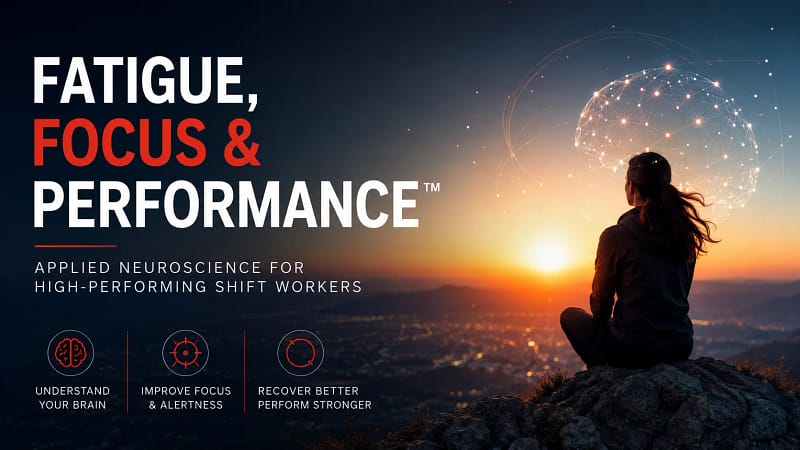
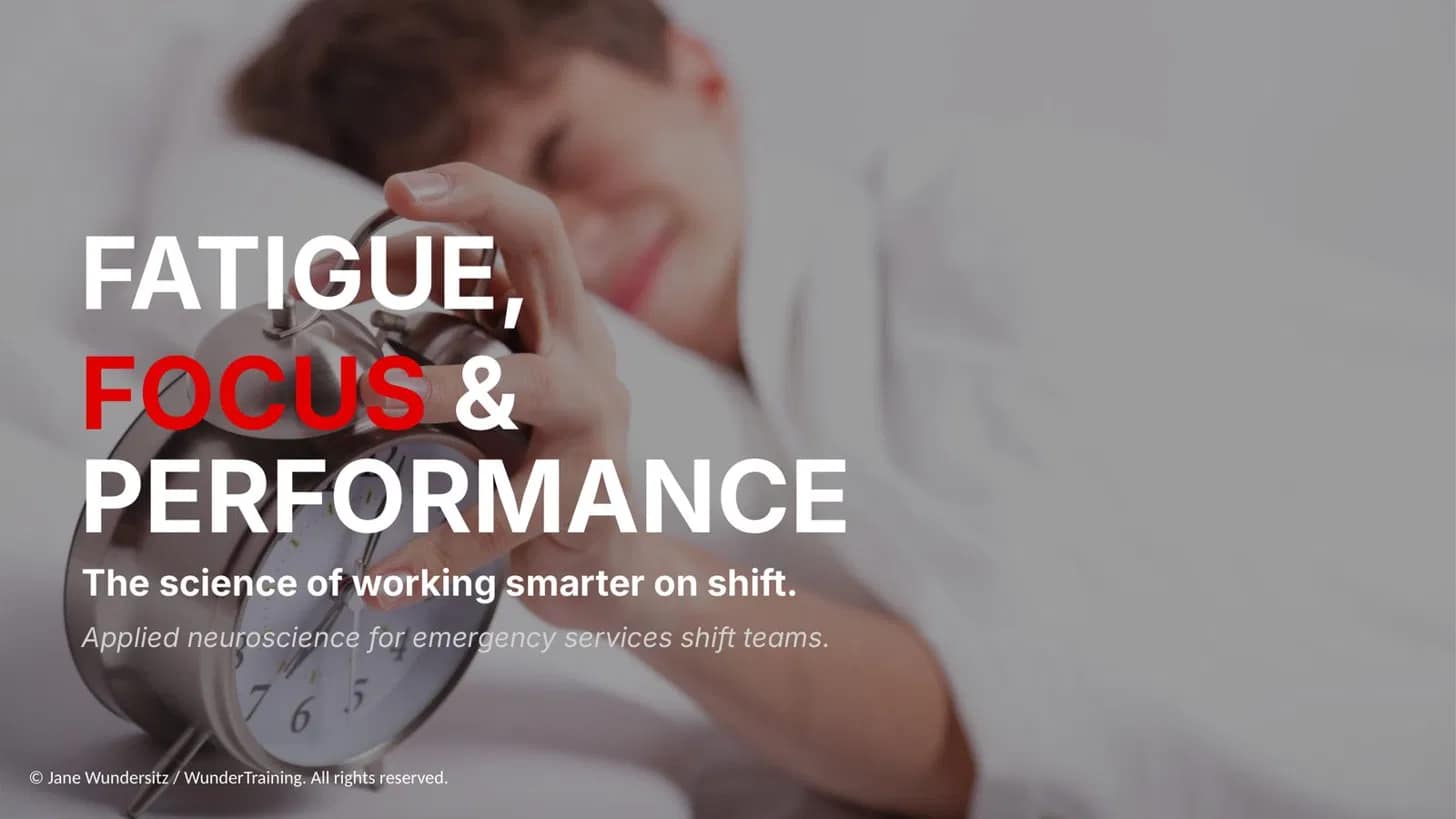
That is why we built Fatigue, Focus & Performance™, our newest program, and why DFES WA was the first organisation to experience it.
Most fatigue training tells shift workers what they already know: shift work is hard. We wanted to do something more useful.
Fatigue, Focus & Performance is a two-hour interactive workshop in applied neuroscience. It explains what is actually happening in the brain on a long or overnight shift, then gives people realistic tools that fit a 24/7 roster, with practical changes they can make on their next shift.
The program is supportive of shift workers from start to finish. The roster is part of the job. What people can control is how they work with their own biology.
One of the first numbers in the workshop tends to stop the room. Research by Dawson and Reid (1997) found that after 17 hours awake, performance drops to a level similar to a blood alcohol reading of 0.05, the legal driving limit in Australia. At 24 hours awake it is closer to 0.10.
For someone working a late finish or a double, that is a normal working day. And the brain functions that suffer first are the ones emergency work depends on most: reaction time, sustained attention, risk assessment, communication accuracy and emotional regulation.
In the workshop, people get to feel this for themselves.
The pen drop
Participants pair up. One drops a pen, the other catches it. Then they do it again, this time while counting backwards from 100 by sevens out loud. The pen falls noticeably further on the second round.
That gap is a tired brain trying to do two things at once. For a call-taker listening, typing, questioning and reassuring at the same time, it is a familiar feeling. The activity makes the science personal in about three minutes.
Sleep strategies that work around a roster
We cover the strategies with the strongest evidence for shift workers, including using light to shift the body clock, building a better sleep environment, and the strategic nap. NASA’s research on pilots found a 26-minute nap improved alertness by 54% and performance by 34%. We also show people the “coffee nap” and why longer naps can leave you groggier than before.
Feeding a sharper brain
Food and water are performance tools. Even 1 to 2% dehydration is enough to affect thinking, so participants leave with a simple shift hydration routine, the brain foods with the strongest evidence behind them, and a caffeine plan that boosts alertness without wrecking the next sleep.
Focus when you are running on empty
Fatigue drains willpower first. We look at why we put off hard tasks, how to prioritise when everything feels urgent, and how to hand over clearly to colleagues who work differently from you.
A personal Shift Performance Plan
Everyone finishes by writing their own Shift Performance Plan: one sleep strategy, one food and hydration goal, and the single change they will make first. One change, made specific. Research from University College London (Lally et al., 2010) found new habits take a median of 66 days to become automatic, so starting small is the smart move.
“Taking time to consider issues with fatigue as a shift worker allowed me to recognise a lot of bad habits that have slowly become normal for me.
Participant, DFES WA
“Very informative science-based approach and use of evidence to support the messaging. An informative session delivered in an engaging and entertaining way.
Participant, DFES WA
Both sessions were delivered by WunderTraining facilitator Camelia, who one participant described as “a very skilled presenter, presenting very dense subject matter whilst also having a laugh and entertaining along the way.” That balance of science and fun is exactly what we design for.
But you can change how you respond to it. That is the heart of this program. Shift workers keep our communities safe around the clock. They deserve training that respects the job and gives them something real to take back to it.
Fatigue, Focus & Performance™ is available as a two-hour in-person workshop or a 90-minute virtual session, for groups of 10 to 1,000+, anywhere in Australia. It suits emergency services, health, policing, transport, utilities and any team that works around the clock.
See the full program details or get in touch to talk about a session for your team.
Stay in the loop with the latest training insights, practical tips, and exclusive offers. Subscribe to the Wunder Training newsletter and receive valuable updates straight to your inbox.
Do not follow where the path may lead.
Go instead, where there is no path and leave a trail.
Jane Wundersitz
© 2025 Wunder Training Austalia. All rights reserved.